
Atlantic Canada is encountering some of the highest rates of sea level rise in the country.
In Nova Scotia, sea levels will rise by up to one metre by the end of the century. Some communities are exploring new strategies to protect the coast from sea level rise and the increased impacts from erosion and storm surge.
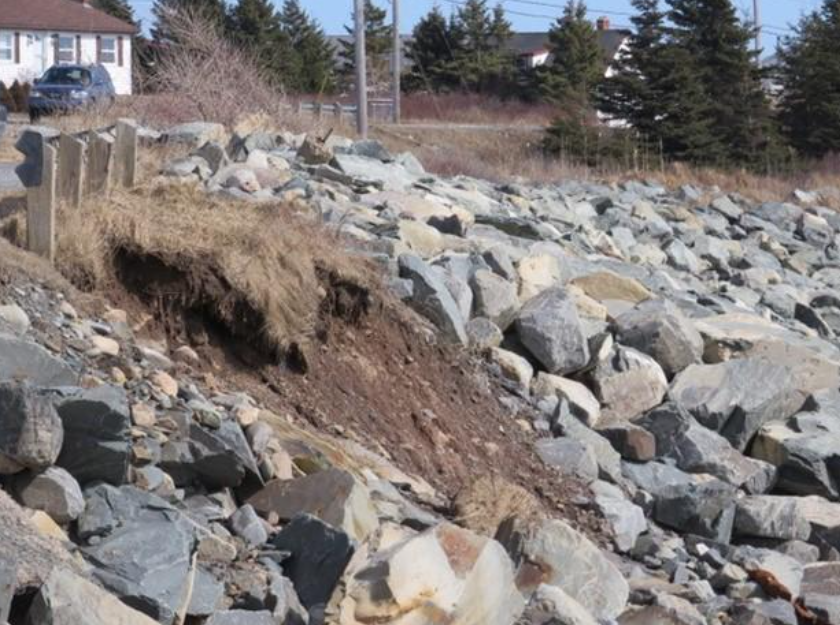
Historically, many communities and property owners have used armour stone — a kind of durable quarry rock — to reduce the impacts of waves. However, this kind of hard infrastructure has some drawbacks.
(Armour stone) can actually, while protecting our section, damage neighbouring sections (of the coast) and lead to more increased negative impacts.
When waves hit a section of the coastline with armour stone, the wave energy is redirected to unprotected areas on either side. This can increase erosion in neighbouring areas and around the stones themselves, causing the rock walls to collapse. Armouring also reduces natural habitat for the plants, animals, and birds that would otherwise live there.
In some cases, communities are looking to work with nature to address coastal erosion, such as a project on Shore Road in HRM.
Re-creating the Natural Shoreline Along Shore Road
Shore Road is an essential transportation route for residents and businesses in Eastern Passage. As the name implies, the road runs closely along the shore. It is increasingly exposed to waves during storms, which increases coastal erosion. As a result, road closures are becoming more frequent.
The Shore Road: Building With Nature project is a $5 million project with Infrastructure Canada providing 60 per cent of the total project costs. HRM anticipates construction will begin during the 2025/26 construction season.
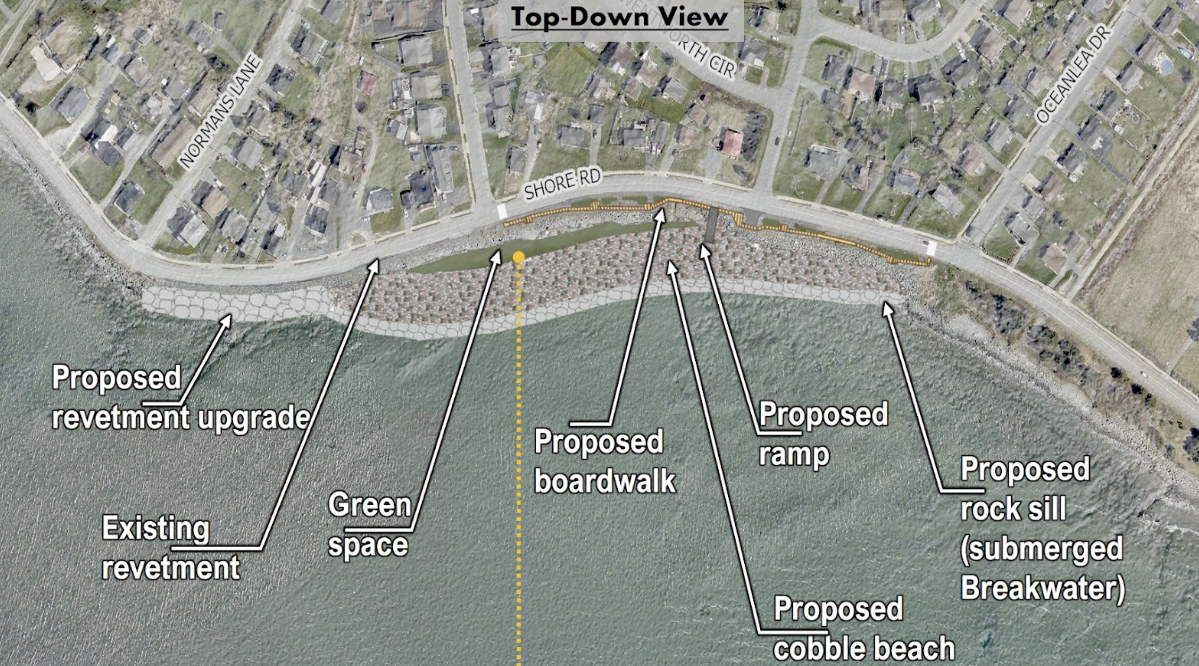
To limit erosion, the project is recreating the cobble beach shoreline that’s typical of the area along a 480m stretch of the Shore Road. The project started with the intention of restoring nearby salt marshes because they can help minimize erosion by buffering the impacts of waves. But the Shore Road site was too exposed to waves from the Atlantic Ocean to support marsh restoration. “Everyone agreed it needed to be a more hybrid approach because of that wave energy,” said Emma Poirier, with the HRM’s environment and climate change team. “That’s just the process — it’s going to be different for every site.”
The project will now use a blend of traditional hard infrastructure and nature-based solutions to limit erosion along Shore Road. Larger pieces of stone will sit below the water and hold the new cobble stone beach in place. Planting the shoreline with native vegetation will help stabilize the slope, filter stormwater, and provide greenspace. Over time, wave action will reshape the beach to a more natural slope that can better withstand strong waves and prevent shoreline erosion. Once complete, a new boardwalk will allow the community to view and get closer to the water.
Overcoming Challenges
This project is one of the first to use nature-based solutions in HRM, and the team has been learning as they go, according to Fernandes. For example, the team learned the importance of site-specific design to restore the natural ecosystem in the area. They conducted a number of modelling studies to determine the best option that can handle the kind of wave action that’s projected with climate change.
“Some other lessons that we learned were about how to really engage with our community and bring community into this project,” Fernandes said. “Through this process, we are building that capacity and that expertise in order to help implement more of these projects in the future and in other areas of HRM.”

Shore Road Serves as a Model for the Future
As part of the project, staff will be applying for a Green Shores certification, a program developed by the Stewardship Centre for British Columbia, which encourages natural shorelines and nature-based approaches.
The best approach for managing coastal erosion will always depend on the site. When deciding on a strategy, it’s important to understand which options work best for the specific conditions. This is where resources like CLIMAltantic’s Coastal Adaptation Toolkit can help.
Alex Cadel, Climate Services Specialist with the Department of Environment and Climate Change and working in partnership with CLIMAtlantic, said that nature-based approaches need to be a bigger part of the conversation than they’ve been historically.
Whether that’s living shoreline approaches, whether that’s restoring salt marsh…that idea of trying to work with nature is a really important one for us when we’re thinking of climate adaptation.
Alex Cadel, Climate Services Specialist with the Department of Environment and Climate Change and working in partnership with CLIMAtlantic, said that nature-based approaches need to be a bigger part of the conversation than they’ve been historically. “Whether that’s living shoreline approaches, whether that’s restoring salt marsh…that idea of trying to work with nature is a really important one for us when we’re thinking of climate adaptation.”
Fernandes agreed: “Nature-based solutions have co-benefits far beyond infrastructure resilience.” The Shore Road project is a great example. It aims not only to slow coastal erosion, but improve stormwater runoff, restore the natural ecosystem and create new public greenspace.
Ultimately, since there are communities at risk beyond Eastern Passage, municipal staff hope the lessons from the Shore Road project will support further projects that harness nature for climate adaptation, both in the municipality and in other communities.
“We are very fortunate to have staff capacity and to have resources because we can share those lessons learned with smaller municipalities who may not have the resources or the risk tolerance to take on something new for the first time without it being proven, tried and true in the Nova Scotia and Eastern Canada context,” Fernandes said.
Additional Resources:
- Nova Scotia Government Coastal Adaptation Resources: http://novascotia.ca/coastal-climate-change
- CLIMAtlantic: https://climatlantic.ca/
- Coastal Adaptation Toolkit: https://climatlantic.ca/coastal-adaptation/
Funding support provided by:

Recent Comments