

Building Atlantic Canada’s Adaptation Workforce
As communities are feeling the brunt of climate change impacts, there is an increasing need to adapt and build resilience. Strong climate adaptation requires communities to be empowered with the skills and knowledge to lead and coordinate adaptation action. CLIMAtlantic is supporting community empowerment by delivering the Climate Adaptation and Resilience Training program (CART). This comprehensive and foundational program is helping to fill growing employment needs in climate adaptation across the Atlantic region.
Are you interested in CART? Participants will gain knowledge and skills to work with communities, organizations, and governments to undertake responsive, effective and equitable adaptation work across Atlantic Canada. You will understand climate adaptation from different perspectives, access a helpful collection of adaptation resources, gain practical experience, and learn to think more holistically while taking part in a safe space to share and experiment. Build your confidence and sense of belonging in the climate adaptation field as you network and create community with other participants and experts across the Atlantic region.
Program audience
The CART program is intended for people in Atlantic Canada who want to address climate change impacts as part of their job (e.g. municipal and provincial government staff, consultants, those in non-profit or Indigenous organizations, watershed groups, and recent grads looking to enter the adaptation field, etc.).
CART helps learners understand and build skills across a range of topics to build a solid foundation in climate adaptation competencies
- Manage adaptation processes and projects
- Understand and use climate information
- Assess risk and vulnerability
- Engage, facilitate, and collaborate across sectors
- Centre equity and Indigenous leadership
- Navigate different governance levels
- Enhance community resiliency
WINTER PROGRAM OVERVIEW : January – March 2026
- 12-week part-time program
- Winter program is virtual
- Total Time Commitment: At least 60-70 hrs (5+ hours per week).
- Six online learning modules, including short homework activities, that participants will complete independently.
- All-cohort kick-off
- Three 1 hour check-ins, and two training sessions to provide an opportunity to practice skills and connect with others in each provincial cohort.
- One all-cohort training day will bring participants from across Atlantic Canada together.
- Final all-cohort half-day gathering with participants from across Atlantic Canada for further peer learning and networking.
- Optional training sessions to choose from
- A certificate of completion will be awarded to participants who complete program components.
- See full program schedule below
Modules and Learning Goals
Module 1 - Understanding Climate Change: Processes, Projections and Possibilities
- Understand different perspectives about climate change, including Indigenous Knowledge
- Understand the science and history behind climate change
- Understand climate change risks and impacts across Atlantic Canada
- Access, retrieve, and use reliable climate information for Atlantic Canada
Module 2 – Risk, Vulnerability and Adaptation
- Understand the importance of equitable climate adaptation and resilience
- Understand what a risk and vulnerability assessment is
- Understand adaptation as an ongoing social process with multiple co-benefits for community resilience
- Share examples of adaptation and understand maladaptation
- Understand and use adaptation tools such as flood hazard maps
Module 3 – Talking Climate: Communication, Engagement and Facilitation
- Communicate about climate adaptation, engage with various audiences, and facilitate difficult conversations
- Plan and design effective engagement events and meetings
- Understand and use basic facilitation skills
- Communicate with people who may not share your views
Module 4 – We're in this Together: Relationship Building, Teamwork, and Leadership
- Build teams and collaborate with diverse people
- Identify ways to build empowerment and decrease barriers in adaptation work
- Know when and how to reach out to experts
- Find out about provincial climate adaptation working groups and communities of practice to connect with
Module 5 – Understanding Systems and Adaptation Process Management
- Understand the concept of systems change
- Plan and implement long-term plans and projects
- Monitor and evaluate your projects
- Take care of yourself and those around you, cope with climate anxiety, and work toward collective resilience
Module 6 – Influencing Change and Navigating Adaptation Across Government Levels
- Navigate climate adaptation across different levels of government and Indigenous governments
- Understand how different levels of government operate and jurisdictional issues
- Manoeuvre the political side of adaptation
- Understand planning and policy processes and ways to influence change
Winter 2026 Program Schedule (All Virtual)
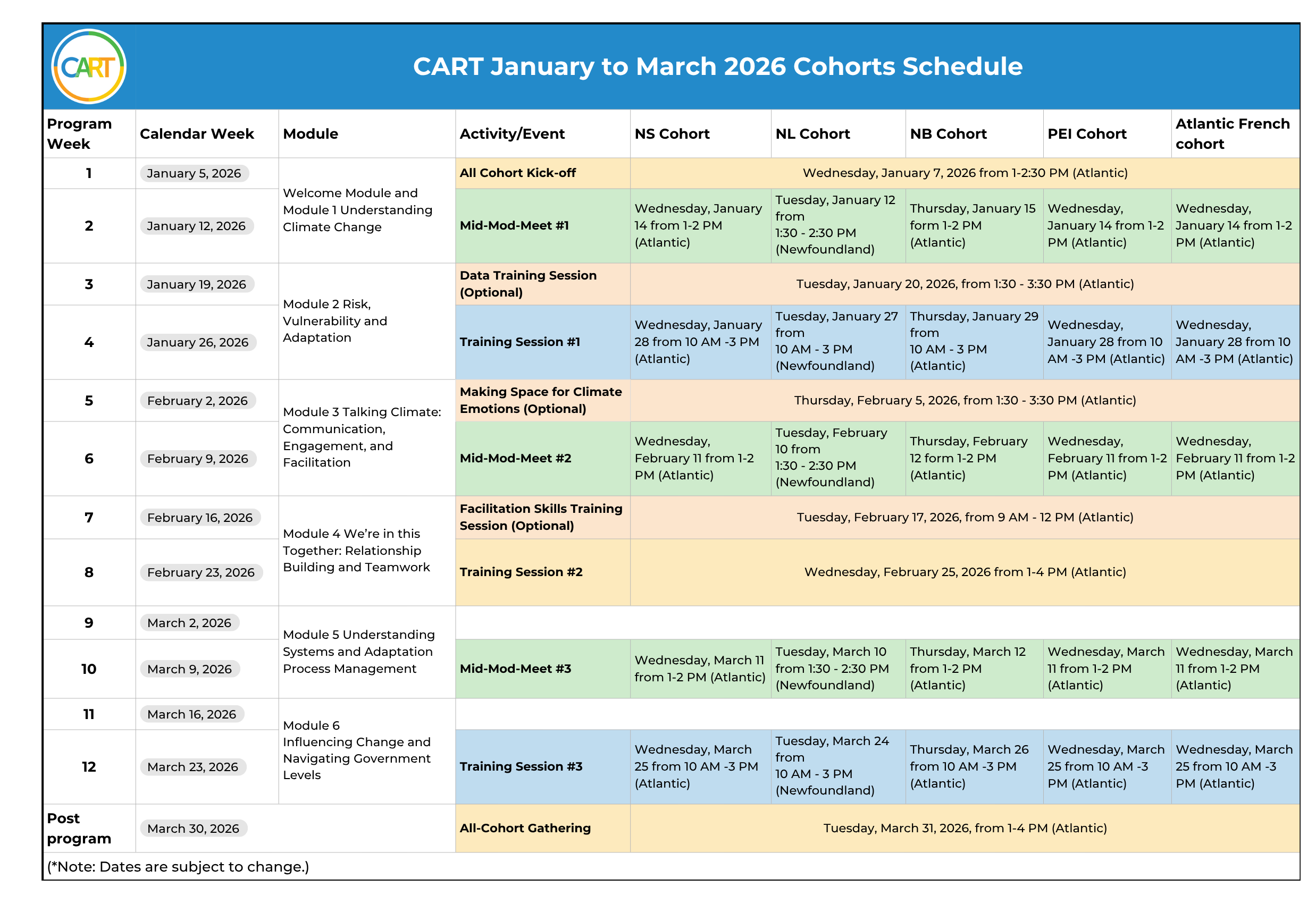
Be part of your Atlantic province cohort
Join a cohort of peers in New Brunswick, Prince Edward Island, Nova Scotia, or Newfoundland and Labrador to network with and learn together.
Cost
Free to apply, but you (or your employer) must cover transportation costs to attend in-person training sessions (Fall program only) in your province. A limited number of travel bursaries is available for eligible participants most in need. Get in touch with us to learn more.
Winter 2026 Application
English Provincial Cohorts: Closed
Atlantic-region Franchophone cohort: Closed
Future intakes: (English and French cohorts)
- September 2026 application opens in Spring 2026.
- January 2027 (Nova Scotia only cohort)
PROVINCIAL COHORT LEADS AND SUPPORT

Amanda Marlin
Program Lead and NS Cohort Lead
Amanda is the Training and Learning Manager at CLIMAtlantic. She has a Master’s of Environmental Studies (Dalhousie University) and was the previous Executive Director at EOS Eco-Energy.

Zaheera Denath
NB Cohort Lead
Zaheera is the Climate Change Adaptation Collaborative Program Coordinator at NBEN. She holds a Masters of Human Kinetics (University of Windsor).

Muntaka Siddique
Program Assistant
Muntaka is the Climate Services Assistant at CLIMAtlantic. She holds an HBSc in Life Sciences (McMaster University), with a background in community engagement and environmental change through the lens of health and equity.

Anna Garf
NS Cohort Lead
Anna is the Engagement Lead at CLIMAtlantic. She holds a Masters in Environmental Practice and Graduate Certificate in the Science and Policy of Climate Change (Royal Roads University).

Timilehin Oguntuyaki
NL Cohort Lead
Timilehin is the Green Career Development & Training Lead at econext. He holds a Masters of Land and Water Systems (UBC) and an Environmental Geoscience PhD Researcher (MUN).

Liz Carr
NS Cohort Support
Liz is the Policy & Planning Specialist with the Community Climate Capacity (CCC) Program with Clean Foundation. She holds a Masters of Planning (MPLAN).

Krystal Pyke
Curriculum Developer and PEI Cohort Lead
Krystal is the ClimateSense Program Manager at the University of PEI. They hold an MA in Environmental Education and Communication (Royal Roads University) and a BEd in Environmental Education (Simon Fraser University).

Charles Thibodeau
Atlantic Region Francophone Cohort Lead
Charles is the Nature-based Climate Approaches Program Coordinator at NBEN. His background is in mechanical engineering, and also a Certified Permaculture Designer and a Community Food Mentor.

Emily Cumming
NL Cohort Support
Emily is the Conservation Manager at Conservation Corps Newfoundland and Labrador. Emily has a M.Sc. in Earth Sciences (Environmental Geochemistry).
TESTIMONIALS
The CART program was so well run and all the information was clear and super informative. I loved the in-person sessions and it was so great to be involved in it all! Thank you so much for organizing.
—NL Participant
My competencies around communication, stakeholder collaboration, climate data and policy… use have all been significantly bolstered via the CART program. I also have so many more resources and connections that support this work. I’m very excited to stay in touch with folks… and begin connecting with nearby municipal and provincial staff. I truly to feel enabled to act!
—NS Participant
I thoroughly enjoyed the face-to-face event, I spent my time meeting people and sharing ideas. I did some brainstorming with people with similar concerns as my own and with ideas I had not perceived. I am expanding my knowledge and abilities in the climate change field and feel like I’m making progress with my climate adaptation goals.
—NB Participant
I feel like I am moving the needle forward on my progress. [CART] made me feel like what I do is valuable and has real-life applications. It was really validating to hear procedural equity mentioned and to see how my research area was relevant to other areas of climate change. It made me feel like I belonged and that my hope for a career in climate change was not so far fetched after all.
—PEI Participant
FUNDED BY


OUR DELIVERY PARTNERS


